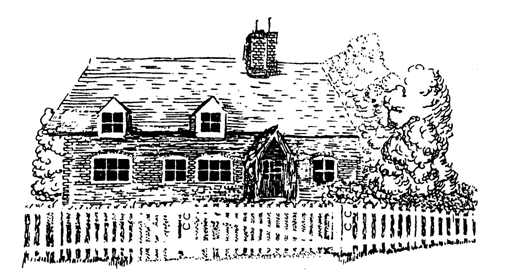
HORSESHOE COTTAGE
There is written evidence that in 1332 John Syred of Ascote, was in dispute with the Bailiff over a payment for land, and on the 12th. August 1461 William Syrot was a witness to the charter that transferred the manor lands to Robert Sloo. It can be suggested that William was the descendant of John, and that he was a landowner of status, to be asked to witness land transactions. After seeing the alterations that Robert Sloo made at the Manor, he had the same builder reconstruct his home, building the more substantial cruck house opposite the Manor, on Syred land.
It can further be suggested that in the new house William and his wife had five sons, as the first grandchild was baptized on 29th. September 1588, and others followed. One of the most descriptive entries in the Parish Register is of the death of another grandchild "Marye, a mayde of Ascitte", on 10th. June 1620 and on 12th. May 1623 of her mother, "Ales, a widow of Ascott". The family had had something to celebrate earlier that year though, when Richard married Elizabeth Bell on 24th. February, thus joining by marriage the two opposite properties and the Syred family acquiring a lady of rank and wealth. By 1660 Henry Syred was taxed at 11s.6d. - he was the eldest brother. Thomas, two years younger, was taxed 2s.0d., but by 1688 his assessment was £2.1s.6d. He must have been a man of some regard, as in 1698 he was sworn in as Vice Petty Constable for Monks Risborough Parish, and Tithing man - to ensure that local taxes and rents were paid. Presumably he had a son William, as in 1724 William Syrett surrendered his lands, possibly because of debt, if he was involved in the South Sea Bubble. The last entry for the Askett branch of the Syred family is in 1727, when John, son of widow Syred, died.
In the 1930's Alf Smith who sold firewood, and his wife and her mother, Mrs Beech, also lived there.
After the war Mrs Fairclough renovated the property, and later Mr and Mrs Leng lived there until 1982. They remember a film being made in their garden about events in the Civil War, when a group of children dressed in Puritan clothing took shelter in the cottage as the Cavaliers rode through the village….. which posits the Hampden suggestion earlier in the book.
Click HERE to return to the map.